
Still on Trial: 22,858 organisations serving trial fonts on live websites
Maxime Yao, FONTRIGHTS (Software Automated Ltd) Data as of mid-November 2026 · Version 1.0
Executive summary
Type foundries give away trial fonts so designers can test a typeface before they buy it. The deal is simple: try it, then licence it. A lot of the time, the second half never happens.
We checked the fonts that live websites actually serve, looking for files that say, inside the font itself, that they are trial or test versions. Across 150 independent and established foundries, here is what we found:
- 23,908 cases at 22,858 organisations. A case is one organisation serving trial files from one foundry. Some organisations do it with several foundries at once: 947 serve trial fonts from two or more.
- An estimated €5.2 million in licences at list price. That is the sum of the smallest web licence that would cover each case, priced from each foundry's own published price list. It is a floor, not a forecast. It ignores back-dated use, larger licence tiers and any penalty terms.
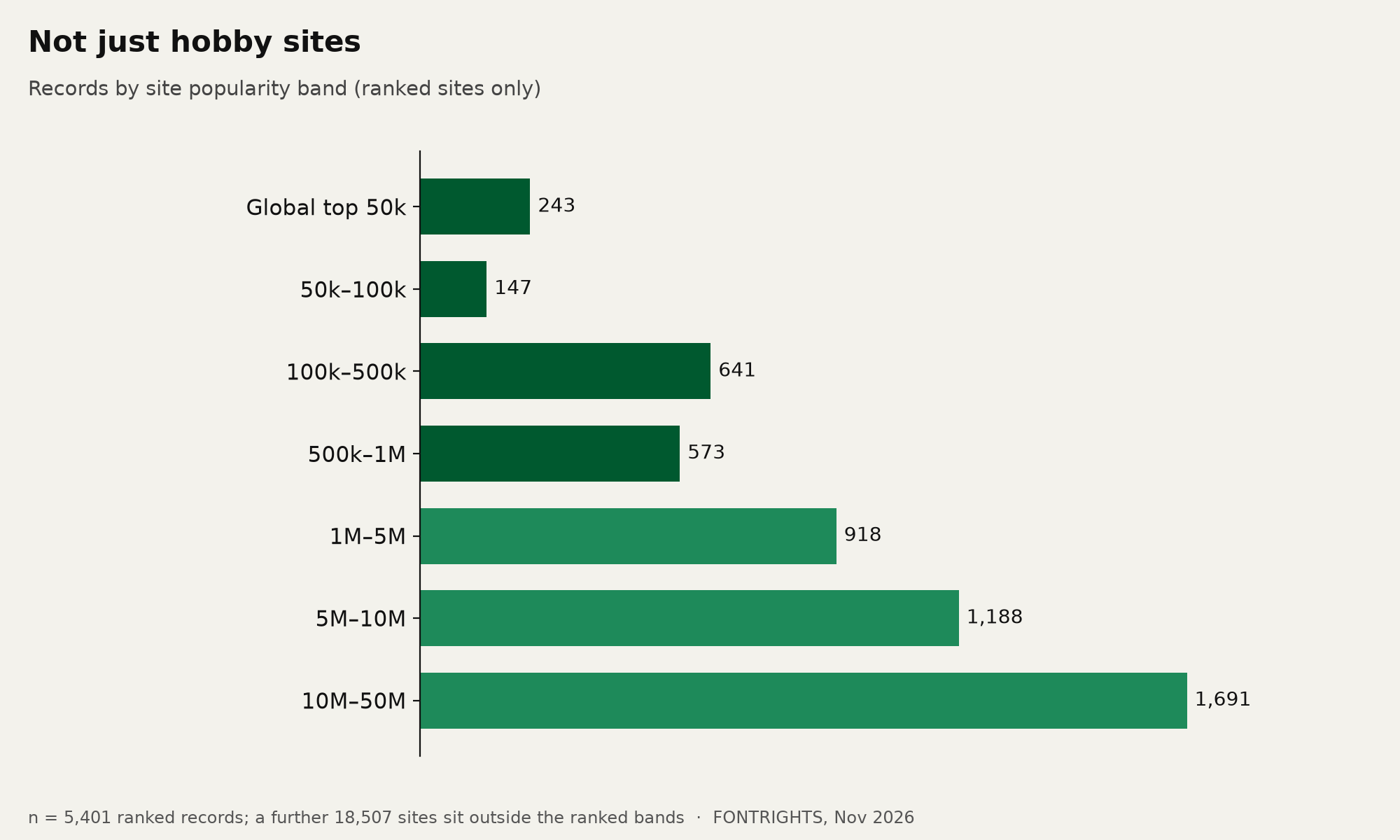
- 1,604 cases sit on sites in the global top 1 million, including 243 in the top 50,000. This is not only a hobby-site problem.
- Files stay up for years. Where the file address carries an upload date (3,332 cases), the median trial file has been live for about 17 months. 68% have been up for more than a year, and 32% for more than two.
- Most are in active use. In a hand-checked sample of 598 loaded pages, 81% visibly rendered the trial font on screen. These are not forgotten files sitting in a folder.
Every case in this report is a potential licence issue, not a legal finding. A site may hold a licence and simply never swapped the file. An agency may have left a trial behind. The point of this paper is the pattern, not any one name.
1. What a trial font is, and why it ends up in production
A trial font (foundries also call them test fonts, demo fonts or "trl" files) is a free, usually cut-down copy of a typeface. Foundries hand them out so you can set a headline, mock up a homepage and show a client before you spend money. The trial licence almost always says the same thing in different words: evaluation only, no published work, no websites. Out of the 150 foundries in this study, we have the trial terms on record for 89, and the wording ranges from "for mockups and tryouts" to "Any published or accessible work, online or offline, is strictly prohibited."
Most foundries mark the file so nobody can mistake it. The family name inside the font carries a word like "Trial", "Test" or "Unlicensed Trial". Some cut the character set down. Some ship a file named with the word "trial" in it. None of that stops the file going live, because nothing in a website build checks it.
Here is how it usually happens:
- The pitch. A designer downloads a trial of a lovely grotesk to show the client three directions.
- The handoff. The client picks that direction. The design file, still pointing at the trial, goes to whoever builds the site.
- The upload. On Webflow, Framer, Shopify or WordPress, adding a custom font means uploading a file. The builder uploads the one they have. It looks right. It ships.
- The silence. Nobody owns the question "did we buy the font?" The agency thinks the client bought it. The client thinks it came with the design. The developer was never asked.
Months later the site is still running the trial file. Our data says that is the normal outcome, not an edge case.
2. The findings
2.1 Scale
| Measure | Figure |
|---|---|
| Foundries checked | 150 |
| Cases (organisation × foundry) | 23,908 |
| Distinct organisations | 22,858 |
| Web hosts merged into those organisations | 26,996 |
| Trial font files confirmed live | 81,820 |
| Estimated list-price value | €5,243,078 |
| Median value per case | €120 |
| Mean value per case | €219 |
We count organisations, not pages or hostnames. A university running trial files on 33 departmental subdomains is one record, not 33. That keeps the headline honest, and it means the real number of affected pages is higher than the number of records.
How the trial status was confirmed matters, too. In 22,497 cases (94%), the font file itself names itself as a trial in its internal naming data. In the other 1,411 cases (6%), the file follows the foundry's own trial file naming. In both cases the evidence is the foundry's own marking, not our guess.
2.2 Site size: from side projects to the global top 50k
Most cases (18,507) are on smaller sites that fall outside the ranked popularity bands. That fits the story: small studios, local businesses, portfolio sites, a new product page knocked out in a weekend.
But 5,401 cases are on ranked sites, and the top end is real:
- 243 cases on sites in the global top 50,000
- 1,604 on sites in the global top 1 million
- Those 1,604 top-1M cases add up to an estimated €409,050 at list price
At the top of the range we see household-name consumer brands, a well-known Japanese electronics group, multinational food and drink businesses, large health brands and several of the best-known universities in the United States and the UK. We will not name them. In many of these cases the trial file sits on a campaign microsite, a regional subdomain or a product launch page, not the main homepage. That is exactly the kind of page an agency builds and nobody audits.
2.3 Industries
We could classify the industry for 11,770 of the 23,908 cases. In that classified set:
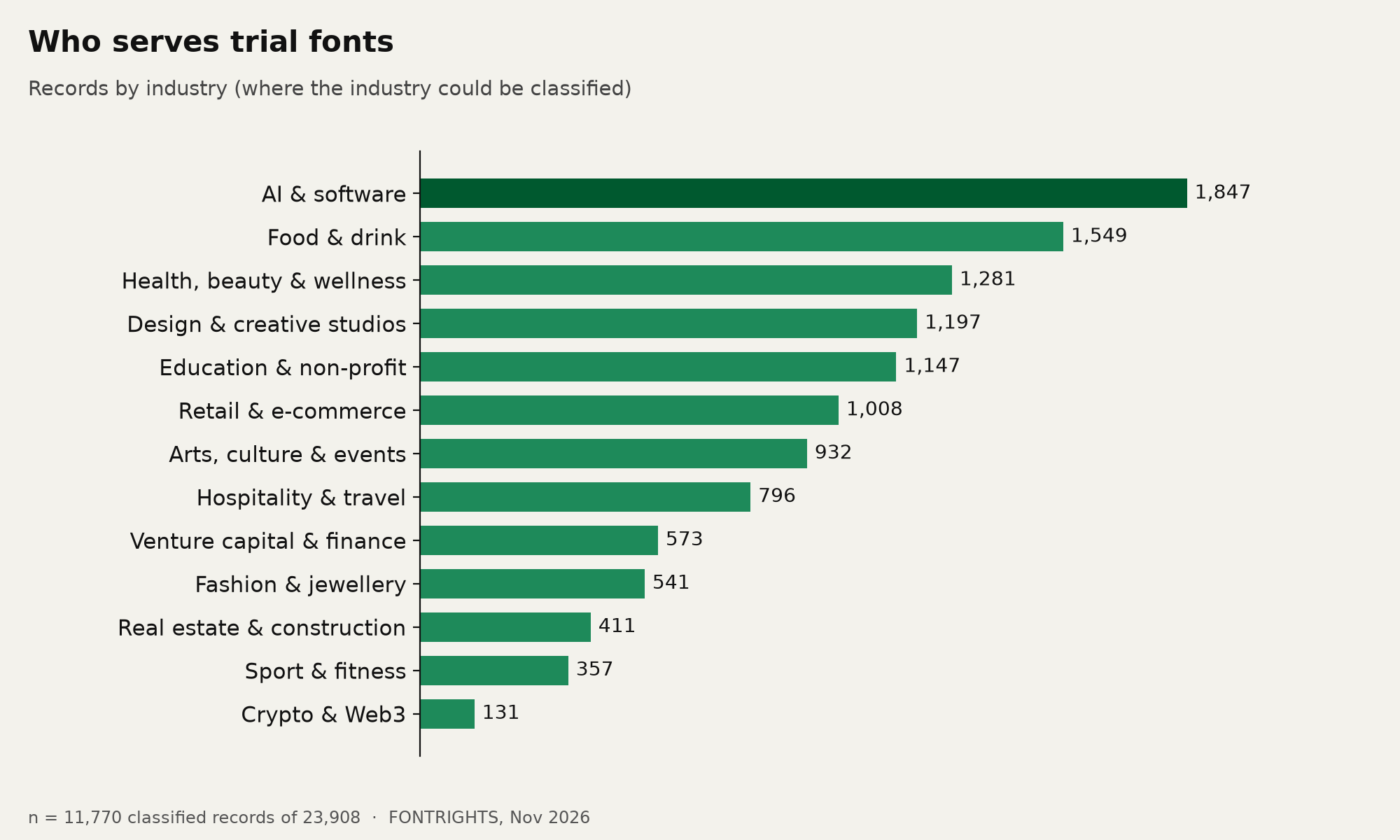
| Industry | Cases | Share of classified |
|---|---|---|
| AI & software | 1,847 | 15.7% |
| Food & drink | 1,549 | 13.2% |
| Health, beauty & wellness | 1,281 | 10.9% |
| Design & creative studios | 1,197 | 10.2% |
| Education & non-profit | 1,147 | 9.7% |
| Retail & e-commerce | 1,008 | 8.6% |
| Arts, culture & events | 932 | 7.9% |
| Hospitality & travel | 796 | 6.8% |
| Venture capital & finance | 573 | 4.9% |
| Fashion & jewellery | 541 | 4.6% |
| Real estate & construction | 411 | 3.5% |
| Sport & fitness | 357 | 3.0% |
| Crypto & Web3 | 131 | 1.1% |
Two things stand out.
AI and software companies lead the list. They are about one in six classified cases. They also skew towards the expensive end: 9.5% of their cases serve a variable font, against 5.0% across the whole dataset, and their median case is worth €198 against €120 overall. Fast-moving teams, launch pages built in a few days, and a design culture that loves a sharp contemporary sans. It adds up.
Design studios are on the list too. 1,197 cases are design and creative studios serving trial fonts on their own sites. These are the people who know what a trial file is. It is a reminder that this is a workflow problem more than a knowledge problem.
Universities show up in force. Using academic domain patterns only (.edu, .ac. and similar), we count 133 academic organisations, 23 of them in the global top 50,000 and 53 in the top 1 million. Typically it is a faculty site, a research centre or an event page, built by a small team or an outside studio.
2.4 Where the files are served from
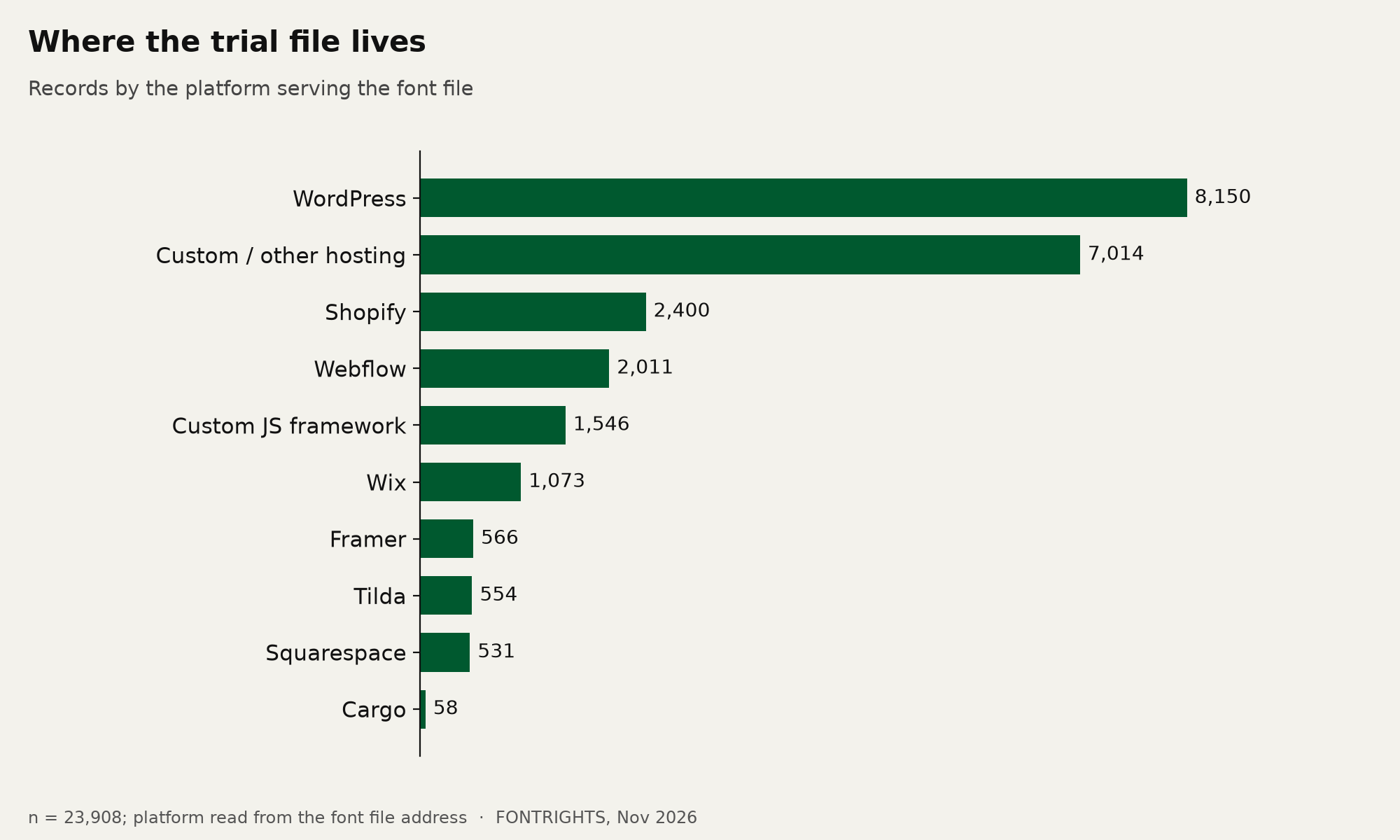
| Platform serving the font file | Cases |
|---|---|
| WordPress | 8,150 |
| Custom or other hosting | 7,014 |
| Shopify | 2,400 |
| Webflow | 2,011 |
| Custom JavaScript framework builds | 1,546 |
| Wix | 1,073 |
| Framer | 566 |
| Tilda | 554 |
| Squarespace | 531 |
Every major site builder lets you upload a custom font file, and none of them checks whether the file is a trial. That is not a criticism of the platforms. A font is just a file to them. But it does mean the decision lands on whoever happens to be clicking "upload".
2.5 What gets served: styles and variable fonts
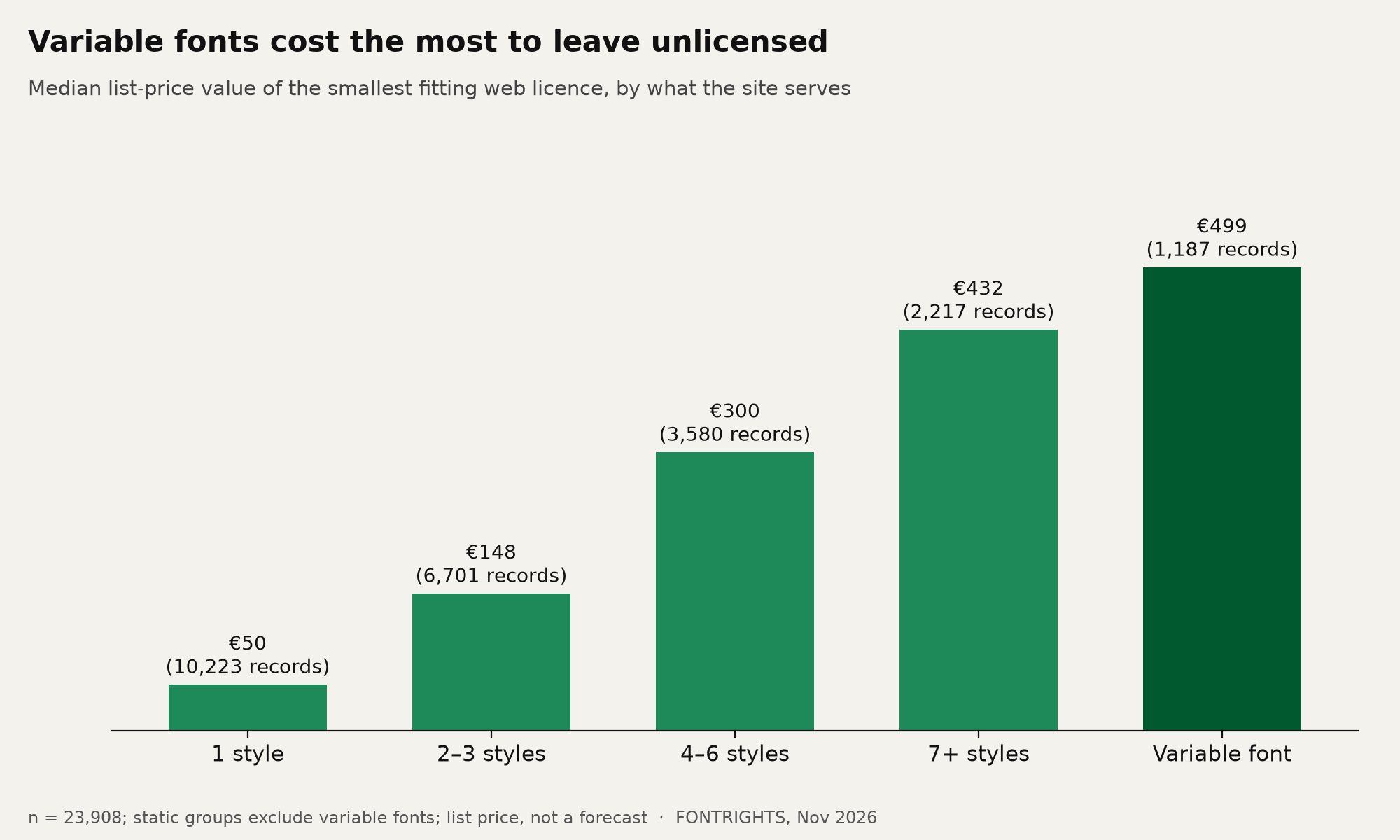
Most cases are small. 11,034 cases (46%) serve a single style: one weight of one typeface, usually for headlines. Another 6,893 serve two or three styles.
At the other end, 1,187 cases (5%) serve a variable font: a single file that contains a whole family's range of weights or widths. Variable fonts are usually licensed as a complete family, so they are expensive to leave unlicensed. Those 1,187 cases account for €835,319, or 16% of the total value, with a median of €499 per case.
2.6 How long trial files stay live
Some site builders write the upload date into the address of every file they host. That gives us an honest clock for 3,332 cases: the date the trial file was uploaded, or last updated.
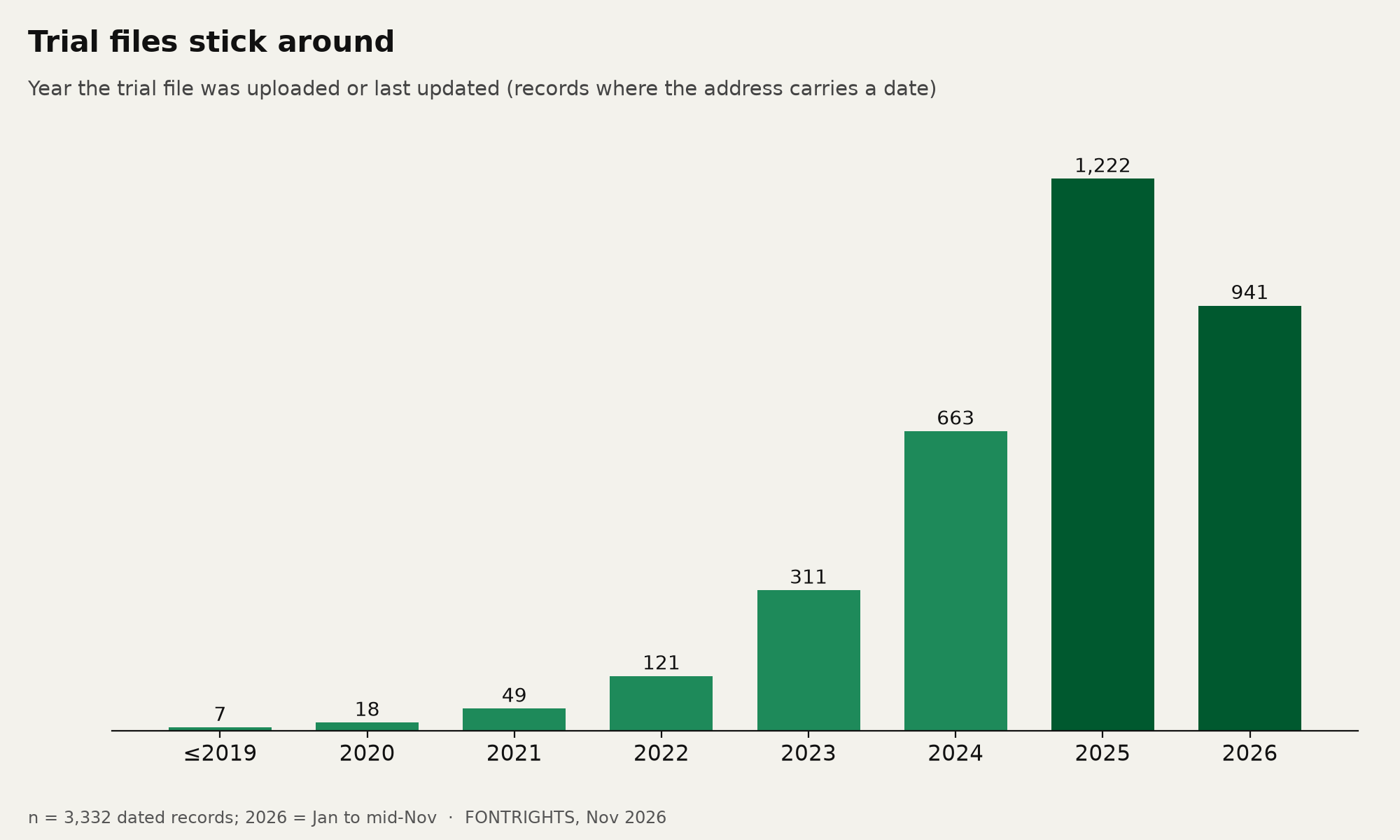
- Median age: about 17 months
- Live for more than one year: 68%
- Live for more than two years: 32%
- Live for more than three years: 14%
- Oldest: a file uploaded in 2018, still served in November 2026
Because the date can be a "last updated" stamp, these are minimum ages. The real figure is likely longer. Either way, trial files do not get cleaned up on their own. Once a site ships, the font is the last thing anyone revisits.
2.7 Are the fonts actually used?
A fair question: maybe the file is on the server but nothing uses it. We loaded a sample of 608 flagged pages in a real browser and looked. Ten were down. Of the 598 that loaded:
- 487 (81%) visibly rendered the trial font on screen
- 43 (7%) loaded the font but we could not see it in use on that page
- 68 (11%) had the file on the server but did not load it on that page
So the large majority are not stray files. They are the brand typeface, in use, on a live page.
2.8 Countries
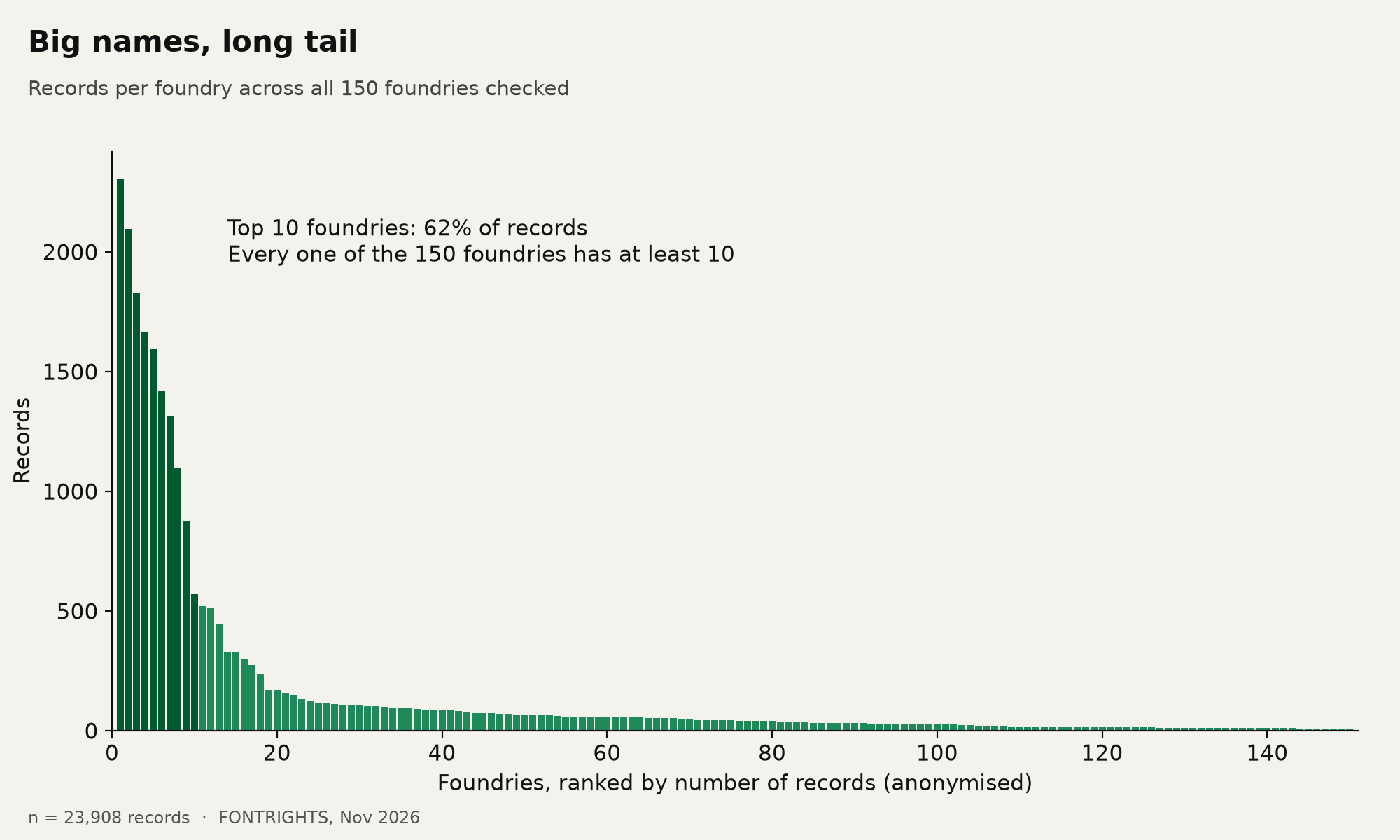
Foundries. The 150 foundries are based in about 28 countries. The largest groups are in the United States (26), Germany (15), the United Kingdom (13), France (13), Switzerland (12) and the Czech Republic (9). The ten foundries with the most cases account for 62% of all records. But every foundry in the study has at least 10 cases, 32 have 100 or more, and 8 have more than 1,000. A two-person studio in Indonesia is as exposed as a well-known Swiss foundry.
Sites. Most organisations use a .com or other generic domain, so we cannot place them by country. Of the 8,281 cases on a country-code domain, the largest groups are Russia (910), Australia (822), Brazil (691), the United Kingdom (672), the Netherlands (510), France (455) and India (396). Treat this as indicative only: plenty of British, American and German companies sit on .com.
2.9 Organisations with more than one foundry's trials
947 organisations serve trial fonts from two or more foundries, and 74 serve trials from three or more. That usually points to a site where several typefaces were tested during design and all of them went live, or to an agency template reused across clients.
3. What it costs foundries
Our value estimate is deliberately conservative. For each case we price the smallest web licence that would cover what the site serves: one style, two styles, a family or a variable font, on the foundry's own published price list, at its lowest traffic or company-size tier, converted to euros. For a handful of very large organisations where the foundry quotes enterprise terms, we use the published floor.
That gives €5,243,078 across 150 foundries. The median foundry in the study has about €6,600 of value outstanding. 59 foundries have more than €10,000, and 11 have more than €100,000.
What this number leaves out:
- Back-dated use. A licence bought today does not cover the 17 months the file was already live.
- Real traffic tiers. We price the lowest tier. A top-50k site is not a 10,000-pageviews-a-month site.
- Desktop and app licences. The team that set the website in a trial font usually set the decks and the social posts in it too.
- Contract terms. Of the 150 foundries, 12 publish an explicit charge above list price for unlicensed use, ranging from a 100% surcharge to three times list, and a few set minimum fees in the hundreds or low thousands. Many others reserve audit rights or the right to recover legal and investigation costs. We do not add any of that.
So €5.2 million is what it would cost to put the visible cases right at the cheapest possible price. It is a floor. It is also money that, for most of these foundries, is a large share of annual revenue.
4. Why it is usually not bad faith
It would be easy to read these numbers as piracy. We do not think most of it is.
- The person who downloads the trial is rarely the person who publishes the site. Responsibility falls between the designer, the developer and the client.
- Trial files look and feel finished. A lot of trials ship with the full Latin set and real metrics, so nothing looks wrong on screen.
- Site builders hide the font file. Once uploaded, it lives in a settings panel nobody opens again.
- Licensing is confusing. Pageviews, company size, desktop seats, apps, variable versus static. A small business owner who thinks "we bought the font" might have bought a desktop licence only.
- Nobody tells them. Our age data shows most of these files sit untouched for over a year. In our experience, when an organisation finds out, the usual reaction is embarrassment and a purchase, not a fight.
That is why we frame every case as a potential licence issue. The goal is to get type designers paid, not to shame anyone.
5. What foundries can do
1. Mark your trials clearly, inside the file. 94% of our cases were confirmed because the foundry put "Trial" in the font's internal names. That one decision makes detection reliable and protects the foundry when it comes to a conversation. Foundries relying only on file names are much harder to check, because file names get rewritten by every site builder.
2. Look, regularly. Trial misuse is not a one-off event. New files go live every week. Our data includes 941 dated uploads from 2026 alone.
3. Lead with a polite, specific note. "We noticed this page serves our trial file. Here is the licence that covers it, here is the price." Most people fix it when they are told clearly and kindly. Save the formal language for the small number who ignore you.
4. Make the fix easy. A direct link to the right licence, a clear price, and a way to cover the time already live without a lawyer. If converting costs the customer an afternoon, many will not.
5. Price the conversation, not the penalty. Your terms may allow surcharges. Your best outcome is usually a happy customer who buys the family and comes back for the next project.
6. Methodology (summary)
We kept the method simple and checkable.
- Discovery. A large-scale analysis of public web pages identified pages that reference font files associated with the 150 foundries in scope.
- Live verification. Every candidate was re-checked live. We downloaded the font file the site actually serves and read it.
- Trial status. A case counts only if the file identifies itself as a trial, either in the font's internal naming data (its name table), or by the foundry's own trial file naming convention.
- One record per organisation. Hostnames and domains belonging to the same organisation were merged, so a site with many subdomains counts once per foundry.
- Evidence. For each case we kept the file address, a fingerprint of the file, the internal names we read, the date checked, and for sampled cases a dated screenshot of the page.
- Context. Site popularity bands and industry labels come from public ranking data and from the site's own content. Upload ages come from dates embedded in file addresses where present.
- Value. Each case was priced at the smallest fitting web licence on the foundry's published price list, converted to euros.
All live checks were run between 13 and 16 November 2026.
7. Limitations
- Potential issues, not findings. We cannot see licences. A site may have bought one and kept the trial file, or bought one for a different format.
- Undercount. We only detect files that identify as trials. Fully unlicensed retail fonts, desktop use, apps, PDFs and social content are out of scope. So are foundries outside our 150.
- Point in time. Sites change. Some cases will have been fixed since we checked; others will have appeared.
- Industry labels are automated and 12,138 cases could not be classified. Shares are of the classified set only.
- Country of site is approximate, based on country-code domains where present.
- File ages come from a 3,332-case subset where a date is available, and are minimums.
- Value uses the cheapest published tier and does not reflect the price any foundry would actually charge in a given case.
- Foundry scope. The 150 foundries include large and small foundries but are not a random sample of all type foundries.
8. How to cite
Yao, M. (2026). Still on Trial: 22,858 organisations serving trial fonts on live websites. Software Automated Ltd (FONTRIGHTS). DOI to be added on Zenodo.
Contact: max@fontrights.com · fontrights.com
Charts in this paper may be reused with attribution to FONTRIGHTS. We do not publish lists of individual organisations or foundries.
See your own numbers
Every foundry on our list has a free masked preview of its verified leads. Recovery costs nothing upfront: we keep 50% of what we recover.
Find your foundry